Planning Guide · Last updated July 9, 2026 · By the ColdDMCalculator team
How to Forecast Cold DM Campaign Results Before You Launch
Most cold DM campaigns aren't planned — they're started. Someone picks a daily send number, writes a message, and hits go. A forecast flips that order: you estimate replies, booked calls, clients, and ROI first, so you find out whether the campaign is worth running before you've spent the time.
Why forecasting beats guessing
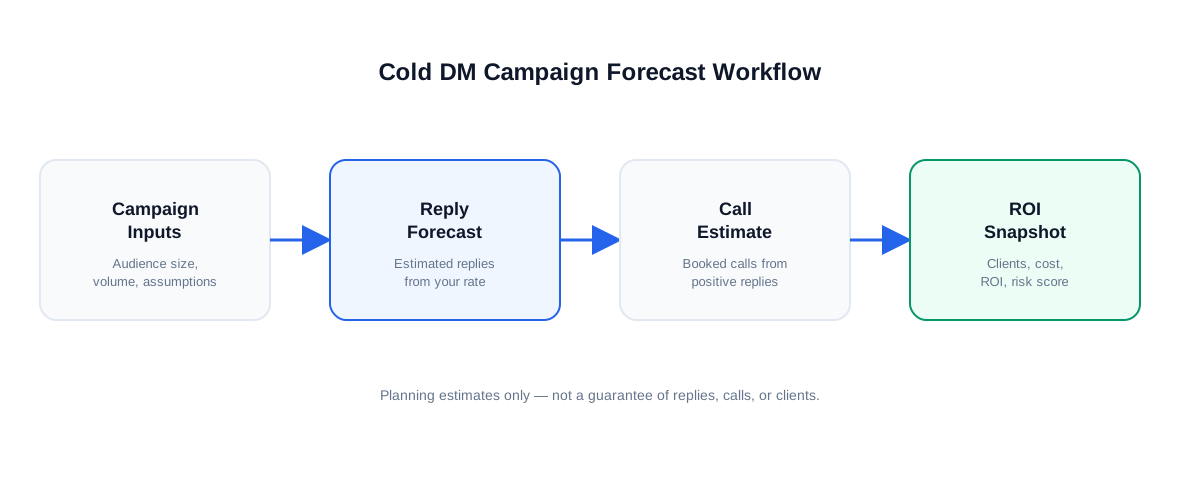
A cold DM funnel has four or five multiplication steps between “message sent” and “client signed.” Each step trims the number down: not everyone replies, not every reply is interested, not every interested prospect books a call, and not every call closes. Small, reasonable-sounding assumptions at each stage compound into a very different bottom line.
A campaign that “feels” strong at a glance — a decent reply rate, a fair booking rate — can still produce zero clients once every stage is multiplied out. Forecasting surfaces that before it costs you weeks of sending time. If you haven't seen the funnel math laid out stage by stage, the how it works guide walks through the formula the calculator uses.
The six inputs every forecast needs
Audience size or planned volume
How many qualified prospects you can realistically reach, or how many DMs you plan to send over the campaign.
Reply rate
The share of DMs that get any response. Pull this from your own history if you have it, or a conservative benchmark if you don't.
Positive reply share
Not every reply is interested — some are declines, some are silence-then-nothing. Estimate the share that's a genuine positive signal.
Booking rate
The share of positive replies that convert into a scheduled call. This depends heavily on how clear your ask is.
Close rate
The share of booked calls that become paying clients.
Average deal value and total cost
Your first-contract deal value (not lifetime value), and the full cost of running the campaign — tools, list research, and your time.
A worked example
Say you plan to send 1,000 DMs. You estimate an 8% reply rate, and that 40% of replies are positive. Of those positive replies, 30% book a call, and 30% of booked calls close. Your average deal is worth $1,500, and the campaign (tools, list building, and your time) costs $1,200.
| 1,000 DMs × 8% reply rate | = 80 replies |
| 80 replies × 40% positive | = 32 positive replies |
| 32 positive × 30% booking rate | = ~10 booked calls |
| 10 calls × 30% close rate | = 3 clients |
| 3 clients × $1,500 revenue − $1,200 cost | = $3,300 profit, ~3.75x ROI |
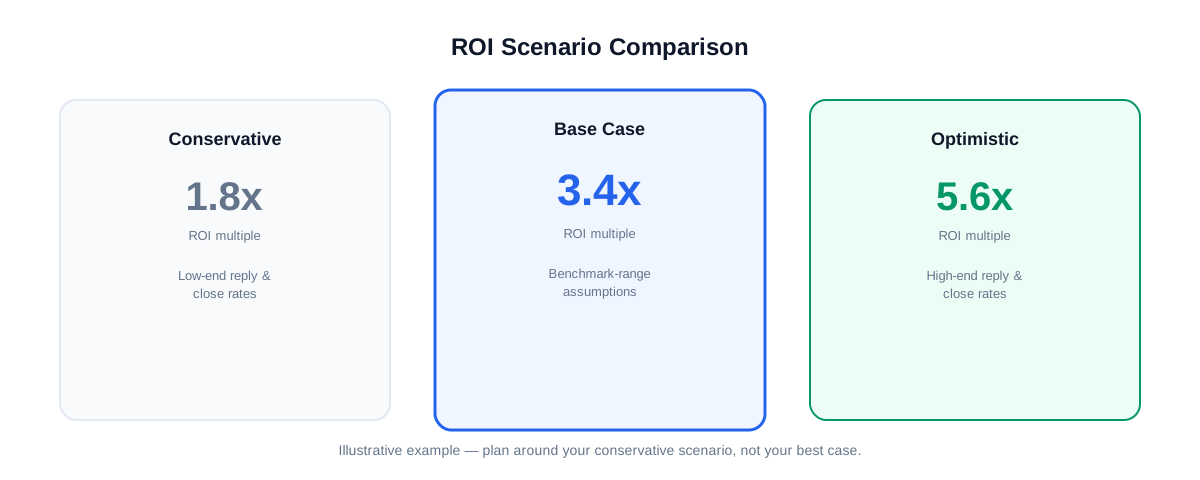
That's the base case. Now drop the reply rate to 5% and the close rate to 20% — a conservative scenario — and the same 1,000 DMs might produce one client, barely covering cost. Building both scenarios, not just the flattering one, is what separates a forecast from a hope.
Turning a forecast into a launch decision
Build three versions of the same forecast: conservative (low-end rates), base case (your realistic expectation), and optimistic (high-end rates). If the conservative case still breaks even or better, the campaign has real margin for error. If only the optimistic case is profitable, you're betting on best-case outcomes stacked on top of each other — a high-risk plan regardless of how good the base case looks.
This is exactly what the free calculator automates: enter your assumptions once and it computes all three stages, flags stacked-optimism risk, and shows your break-even DM count. For a deeper look at ROI-specific math, see the ROI calculator guide.
Common forecasting mistakes
- Picking the high end of every stage at once — reply rate, booking rate, and close rate can't all be your best-case number simultaneously.
- Valuing your own time at zero when calculating campaign cost.
- Using lifetime value as the revenue number while paying costs out of this month's cash — pick one basis and label it clearly.
- Forecasting once and never updating the model with real campaign data.
- Skipping the conservative scenario entirely and launching only on the base-case numbers.
Pre-launch checklist
Before you trust a forecast enough to launch on it, confirm:
- Your rates come from real history or a conservative benchmark, not hope.
- You've built a conservative scenario alongside the base case.
- Total cost includes tools, list research, and your own time.
- The forecast is profitable even at conservative rates.
- Your planned volume and pace comply with the platform's rules.
For the full pre-launch process, see the campaign risk checklist and the campaign planning checklist.
Frequently asked questions
What's the minimum number of inputs I need to forecast a campaign?
Six: audience size (or planned volume), reply rate, positive reply share, booking rate, close rate, and average deal value. Add your total campaign cost and you can compute ROI and break-even too.
Where do I get realistic reply and close rates if I've never run a campaign?
Start with conservative, published benchmark ranges rather than picking optimistic numbers out of hope. Treat your first forecast as a hypothesis, then replace every assumption with your own data after a few hundred DMs.
Should I forecast one scenario or several?
Build at least two: a conservative case using low-end rates, and a base case using your realistic expectation. If the conservative case is still profitable, the campaign has a real margin for error.
Does a good forecast guarantee the campaign will work?
No. A forecast is a planning estimate based on the assumptions you provide — it is not a guarantee of replies, booked calls, clients, or revenue. Actual results depend on your offer, audience, message quality, and platform rules.
Forecast your campaign in under a minute.
Enter your assumptions and get replies, booked calls, clients, and ROI instantly.
Forecasts are estimates based on user-provided assumptions. Results are not guaranteed.
Related: Campaign Planning Checklist · Campaign Mistakes to Avoid · Benchmark Guide · Contact us with questions.