Planning Guide · Last updated July 9, 2026 · By the ColdDMCalculator team
10 Cold DM Campaign Mistakes That Kill Your Reply Rate
Most underperforming cold DM campaigns aren't hurt by one dramatic error — they're hurt by a handful of small, avoidable mistakes that compound. Here are the ten most common ones, what each costs you, and how to fix it before your next campaign.
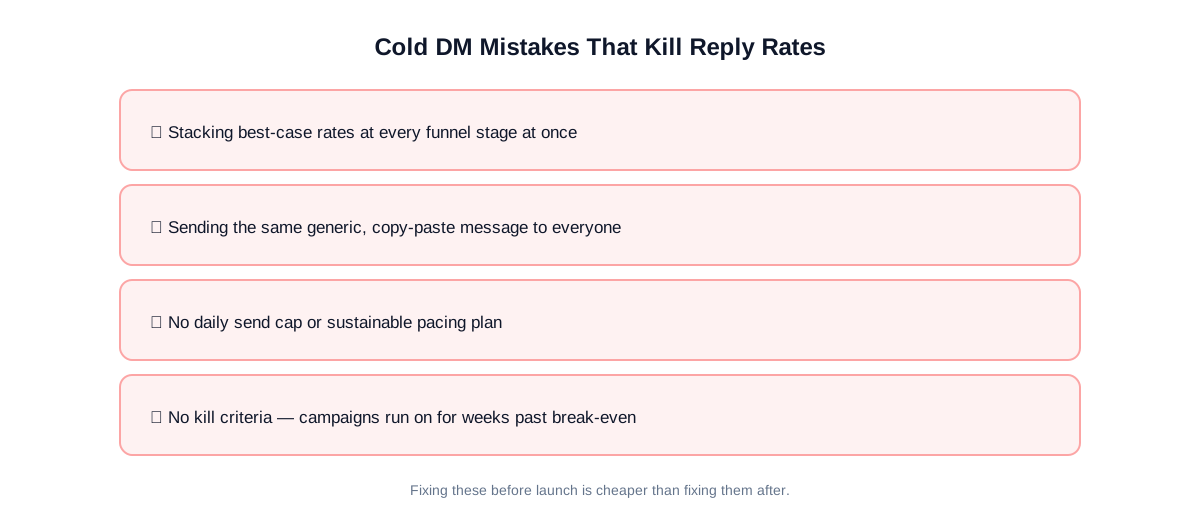
1. Stacking best-case rates at every funnel stage
The problem: Picking the high end of reply rate, booking rate, and close rate all at once produces a forecast that's mathematically impossible to hit — each stage independently being your best case is far less likely than any one of them being.
The fix: Use conservative or median rates for the base case, and reserve best-case numbers for a clearly labeled optimistic scenario.
2. Sending the same message to everyone
The problem: A generic, copy-paste DM reads as automated the moment a recipient sees it, and reply rates drop sharply compared to messages that reference something specific about the person or their work.
The fix: Segment your list and write at least one specific, verifiable detail into each opening line — even a short one.
3. No daily send cap or sustainable pace
The problem: Sending in large bursts to hit a volume target fast increases the chance of tripping platform rate limits or looking automated, and doesn't leave time to reply to conversations as they come in.
The fix: Set a daily cap well under the platform's stated limits and spread volume evenly across the campaign window.
4. Ignoring platform-specific messaging limits
The problem: Every platform enforces its own limits and terms of service around unsolicited messaging, and these change over time. Treating one platform's norms as universal risks account restrictions.
The fix: Review the current terms for the specific platform you're using before each campaign, not just once at the start.
5. Slow reply response time
The problem: A prospect who replies with interest and doesn't hear back for two days has often moved on mentally, even if they don't say so explicitly.
The fix: Block dedicated time each day to respond to new replies within hours, especially in the first 48 hours of a campaign.
6. No kill criteria
The problem: Without a predefined stop condition, underperforming campaigns often run for weeks past the point where the data already showed they weren't working.
The fix: Write down a specific threshold before launch — for example, pause and re-evaluate if reply rate is under a set percentage after the first few hundred DMs.
7. Valuing your own time at zero
The problem: Excluding your own hours from campaign cost makes ROI look artificially strong and can lead to running unprofitable campaigns that only 'work' because your time was free.
The fix: Assign your time a real hourly value and include it in total campaign cost before forecasting ROI.
8. Using scraped lists or fake engagement
The problem: Lists built from scraped private data or engagement from fake/purchased accounts violate most platforms' terms and put your account and reputation at risk.
The fix: Build lists from public, permissible sources and grow real engagement organically.
9. No tracking beyond memory
The problem: Without a simple log of DMs sent, replies, calls, and clients, it's impossible to know your real rates — which means every future forecast is still a guess.
The fix: Track basic funnel numbers in a spreadsheet or the dashboard from day one, even for a small test batch.
10. Never re-forecasting with real data
The problem: Treating the pre-launch forecast as final means you keep planning off assumptions long after real performance data is available.
The fix: Re-run the forecast with actual rates after the first few hundred DMs and adjust volume or targeting accordingly.
A quick self-audit
Before your next campaign, check whether you can answer “yes” to each of these:
- My forecast is profitable at conservative, not just optimistic, rates.
- Every message has at least one specific, personalized detail.
- My daily send volume is well under the platform's stated limits.
- I have time blocked daily to respond to replies quickly.
- I've written down a kill criterion before launch.
- My cost estimate includes my own time.
For the full version of this audit, see the campaign planning checklist and the risk checklist, or run your assumptions through the calculator to get an automatic risk score.
Frequently asked questions
Which of these mistakes has the biggest impact on reply rate specifically?
Generic, non-personalized messaging (#2) tends to have the most direct effect on reply rate. Stacked-optimism forecasting (#1) doesn't hurt reply rate itself, but it distorts what you expect from whatever reply rate you do get.
Can fixing these mistakes guarantee a higher reply rate?
No. These are common, avoidable errors that hurt performance — fixing them removes self-inflicted drag on your campaign, but reply rates still depend on your offer, audience, and platform, and are never guaranteed.
How do I know if my campaign has one of these problems?
Run your current assumptions through the risk checklist and the calculator's risk score, which flags stacked-optimism forecasts and negative-profit scenarios automatically.
Check your campaign for these mistakes automatically.
The free calculator flags stacked-optimism assumptions and negative-profit scenarios.
Forecasts are estimates based on user-provided assumptions. Results are not guaranteed.
Related: Campaign Planning Checklist · How to Forecast Campaign Results · Risk Checklist · Contact us with questions.