Comparison Guide · Last updated July 9, 2026 · By the ColdDMCalculator team
Cold DM vs Cold Email ROI: Which Channel Wins for Your Offer?
“Which channel is better” is the wrong question — cold DM and cold email solve different problems and answer to different constraints. The useful question is which channel produces a stronger ROI forecast for your specific audience, offer, and volume plan. Here's how to model that comparison properly instead of guessing.
Same ROI formula, different inputs
ROI is computed the same way regardless of channel: revenue from closed clients divided by total campaign cost. What changes between cold DM and cold email is the realistic range for each input feeding that formula — reply rate, achievable volume, and the cost of producing and sending each message.
Replies = Volume × Reply Rate
Booked Calls = Replies × Positive Reply Share × Booking Rate
Clients = Booked Calls × Close Rate
ROI = (Clients × Deal Value − Cost) ÷ Cost
Run this formula once for your cold DM assumptions and once for your cold email assumptions using the ROI calculator, and compare the outputs side by side rather than relying on general channel reputation.
Where the channels typically differ
Volume ceiling
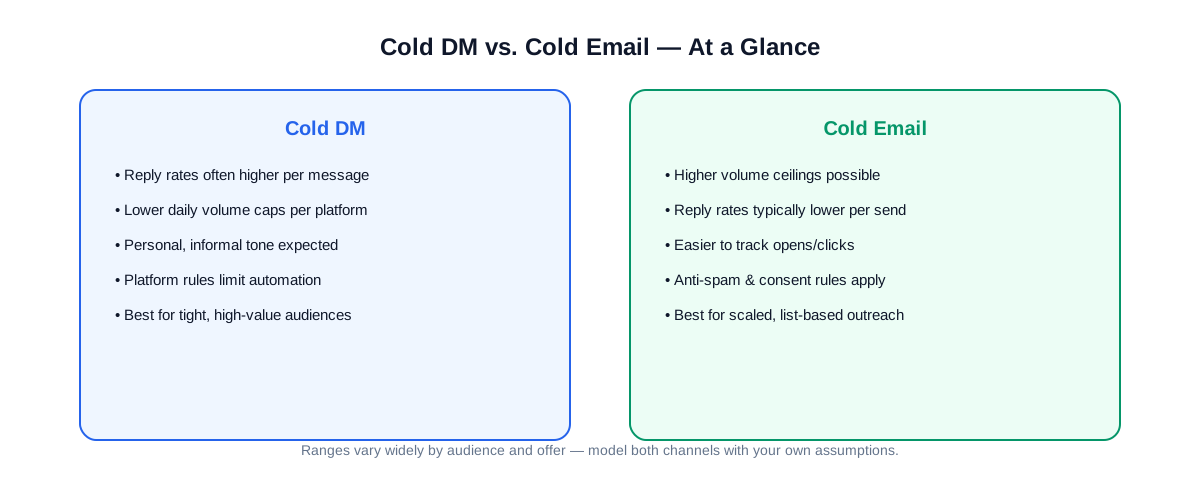
Social platforms impose daily and weekly DM limits, and personalization takes time — realistic cold DM volume is usually a few dozen to a few hundred messages per day per sender. Cold email, sent through a properly warmed domain, can typically scale to much higher daily volume.
Reply rate character
A DM lands in a more personal, conversational context, which can produce higher engagement per message when it's well targeted. Email reply rates per message are often lower, but the gap can be offset by much higher volume.
Personalization effort
DMs generally need a more individually tailored opening line to avoid looking automated. Email supports templated personalization at scale (merge fields, segment-based variants) more naturally.
Compliance surface
DM outreach is bound by each platform's terms of service and messaging-limit enforcement. Cold email carries statutory anti-spam obligations (like CAN-SPAM in the US or CASL in Canada) around consent, identification, and opt-out handling. Both require you to follow the applicable rules — neither is a shortcut around compliance.
A worked side-by-side example
These numbers are illustrative only — replace them with your own assumptions before drawing conclusions for your offer.
| Metric | Cold DM | Cold Email |
|---|---|---|
| Monthly volume | 600 | 4,000 |
| Reply rate | 7% | 2.5% |
| Replies | 42 | 100 |
| Est. clients (after funnel) | 2 | 3 |
| Monthly cost | $700 | $900 |
| ROI multiple (at $1,500/client) | ~3.3x | ~4.0x |
In this illustration, email edges out DM on ROI mostly because of volume, not message quality. Change the audience to one where DMs land far better than email — say, a niche where prospects rarely check email but are active on a social platform — and the result flips. That's why the comparison has to run on your assumptions, not a generic ranking.
When each channel tends to win
- Cold DM tends to win for small, high-value, well-defined audiences where a personal, platform-native approach builds credibility faster than an inbox message would.
- Cold email tends to win when you need volume, have a large addressable list, and can support the infrastructure (domain warming, deliverability monitoring) that email at scale requires.
- A blended approach often performs best in practice: DM for a short list of top targets, email for reach across the rest of the market.
Common mistakes
- Comparing channels using someone else's benchmark instead of your own forecast.
- Ignoring the cost of the infrastructure each channel needs (list tools, domain warming, VA time).
- Assuming higher reply rate always means higher ROI — volume and close rate matter just as much.
- Running both channels to the exact same prospect without tracking which one gets credit for the reply.
Frequently asked questions
Which channel has a higher reply rate, cold DM or cold email?
It depends heavily on platform, audience, and message quality — there's no universal answer. Directionally, cold DMs on social platforms often see higher reply rates per message than cold email, but cold email usually supports much higher volume, so total replies can still favor email at scale.
Can I run both channels for the same campaign?
Yes — many operators run a blended approach: cold DM for a narrow, high-value target list, and cold email for broader volume. Forecast each channel separately since their cost structures and rate assumptions differ.
Does this comparison apply to every industry and offer?
No. These are general channel characteristics, not guaranteed outcomes for your specific offer. Model your own assumptions for both channels using your real or benchmark rates before deciding.
Which channel has more compliance risk?
Both carry compliance obligations. Cold email is subject to anti-spam frameworks like CAN-SPAM and CASL depending on your audience's location. Cold DM is governed by each platform's terms of service and messaging limits. Neither channel is exempt from privacy or consumer protection law.
Model both channels before you pick one.
Run your DM and email assumptions through the ROI calculator and compare the outputs directly.
Forecasts are estimates based on user-provided assumptions. Results are not guaranteed.
Related: Cold DM ROI Calculator · Outreach ROI Template · Campaign Mistakes to Avoid · Contact us with questions.