5-Step Cold DM Framework: Write Better Messages That Get Replies
A good cold DM does not need to be clever, long, or aggressive. It needs to feel specific, relevant, useful, credible, and easy to answer. This guide breaks down a simple 5-step cold DM framework you can use for Instagram, LinkedIn, X, Facebook, or any platform where your first message has to earn attention quickly.
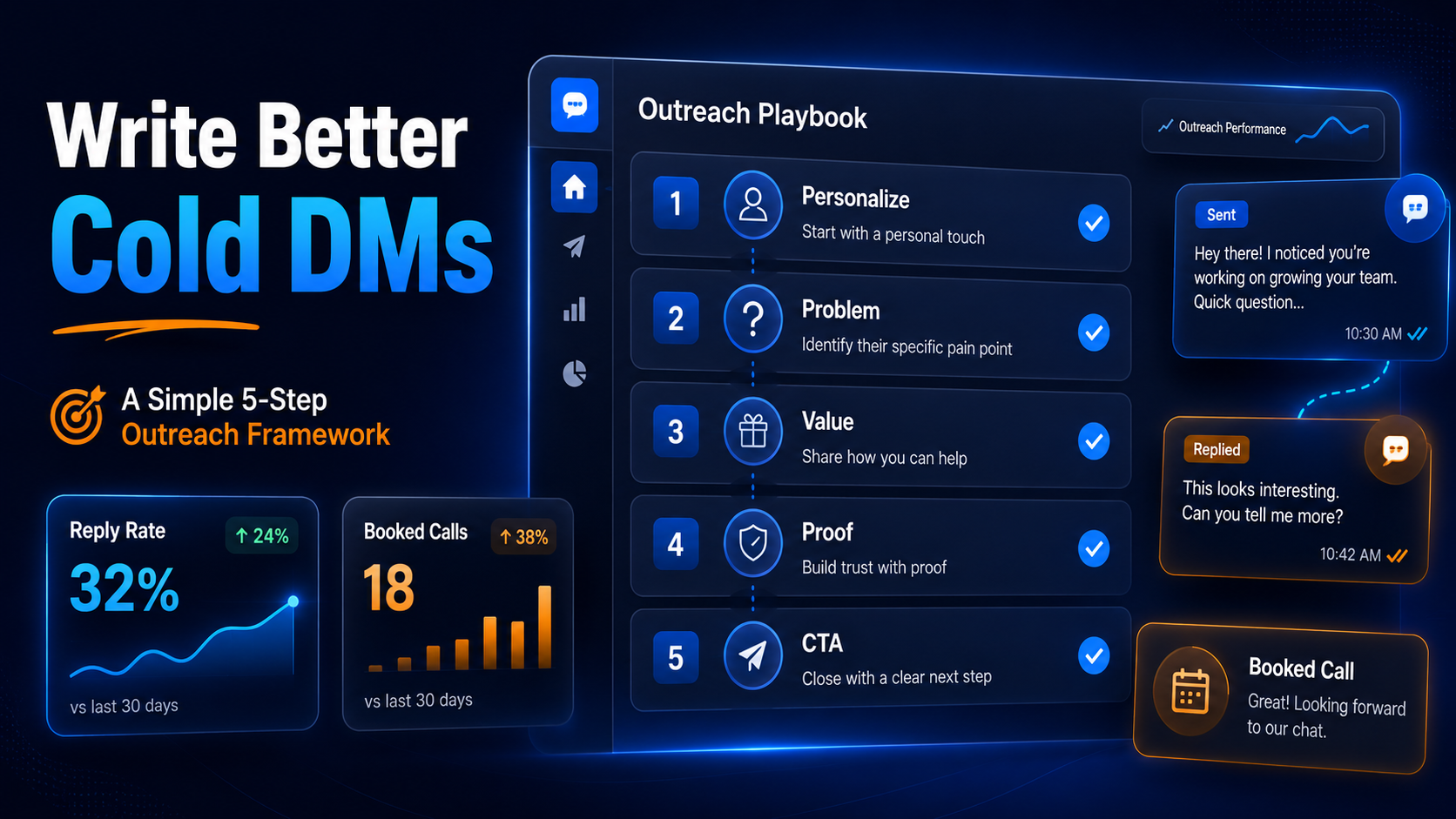
The Framework in One View
The 5-step cold DM framework is simple: personalize, name the problem, show value, add proof, and close with a clear CTA. Each step has a job. If one is missing, the message usually feels either generic, salesy, vague, or hard to answer.
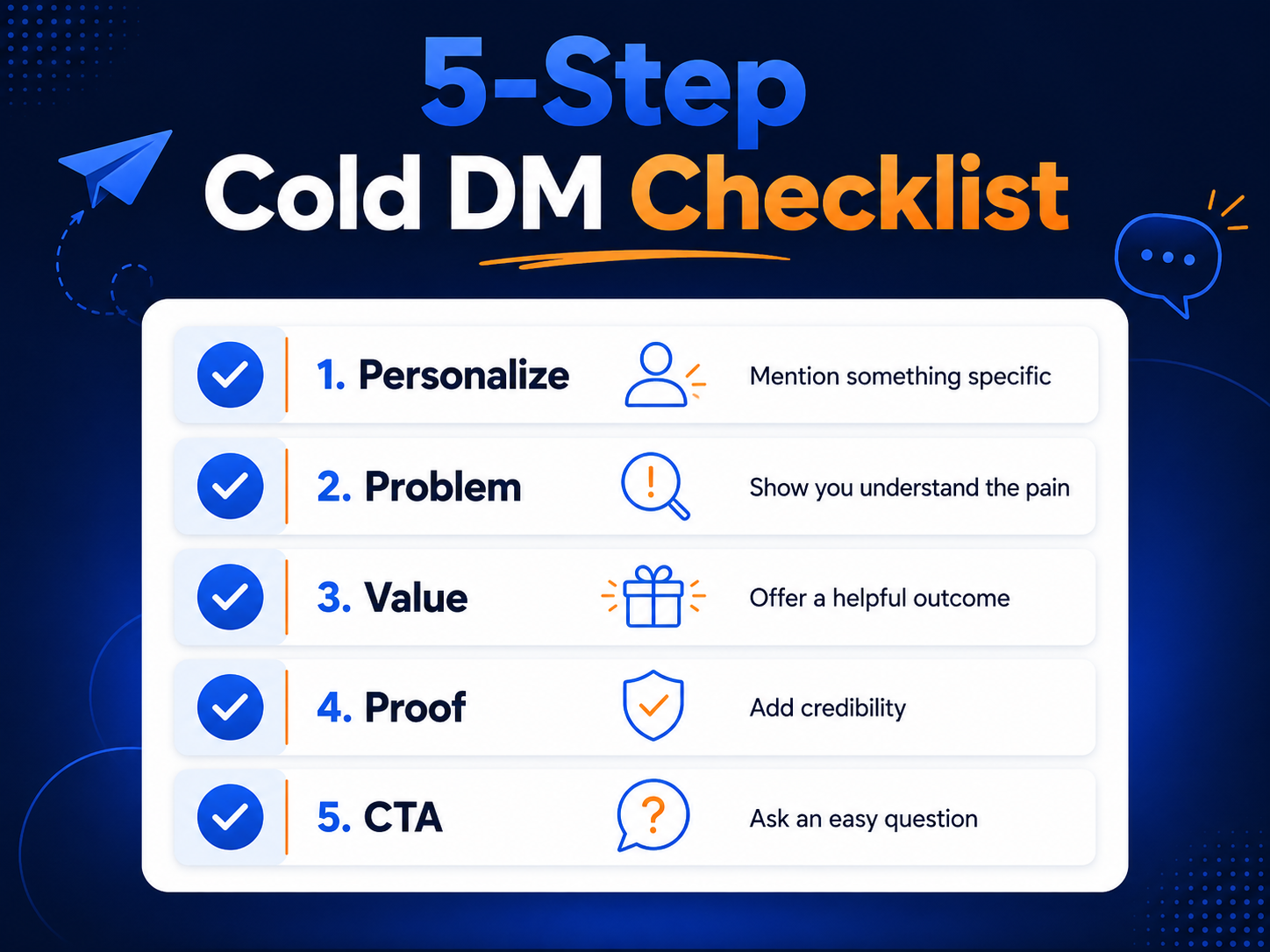
The goal of the first DM is not to close the sale. The goal is to start a relevant conversation with someone who has a reason to care.
Step 1: Personalize Before You Pitch
Personalization is the part most people claim to do, then skip. A first line like "I came across your profile" does not prove anything. Anyone could send it to anyone. A personalized opener should show that you noticed something specific about the person, their company, their content, their role, or their current priority.
Good personalization is not flattery for its own sake. It is context. It gives your message a reason to exist in their inbox.

| Weak opener | Better opener |
|---|---|
| Hi, I came across your profile. | Hi Maya, I saw your post about scaling content production without losing quality. |
| Love what you are doing. | Congrats on opening your second clinic. The hiring push you posted about caught my eye. |
| I wanted to connect. | I noticed your agency is adding Shopify clients, especially in home goods. |
Spend 60 seconds looking for one useful signal. Recent posts, job listings, product launches, podcast appearances, portfolio updates, hiring pages, and founder updates all work. The opener should be real enough that the recipient can tell it was written for them.
Step 2: Name the Problem They Already Care About
Once you have context, connect it to a problem. This is where many cold DMs become too broad. "We help businesses grow" is not a problem. "Keeping content quality high while publishing more often" is a problem. "Turning more DMs into booked consults" is a problem. "Following up without sounding pushy" is a problem.
The problem should feel close to what they are already doing. If it feels random, the message loses trust.
For an agency: "A lot of agencies hit a wall when referrals slow down and outbound starts feeling inconsistent."
For a coach: "When your audience is engaged but discovery calls are uneven, the gap is usually in the first conversation."
For a SaaS team: "Teams often have good traffic, but the handoff from interest to booked demo gets leaky."
Do not exaggerate. You are not diagnosing their entire business from one profile. You are making a reasonable, specific observation and giving them a chance to confirm or correct it.
Step 3: Offer Value in Plain Language
Value is not a list of services. It is the outcome your work helps create. Instead of saying you provide consulting, automation, content, ads, or lead generation, translate that into the result the recipient actually wants.
| Service language | Value language |
|---|---|
| We do outreach strategy. | We help teams turn cold DMs into predictable booked calls. |
| We build automations. | We help founders follow up faster without adding admin work. |
| We create content systems. | We help teams publish more consistently without lowering quality. |
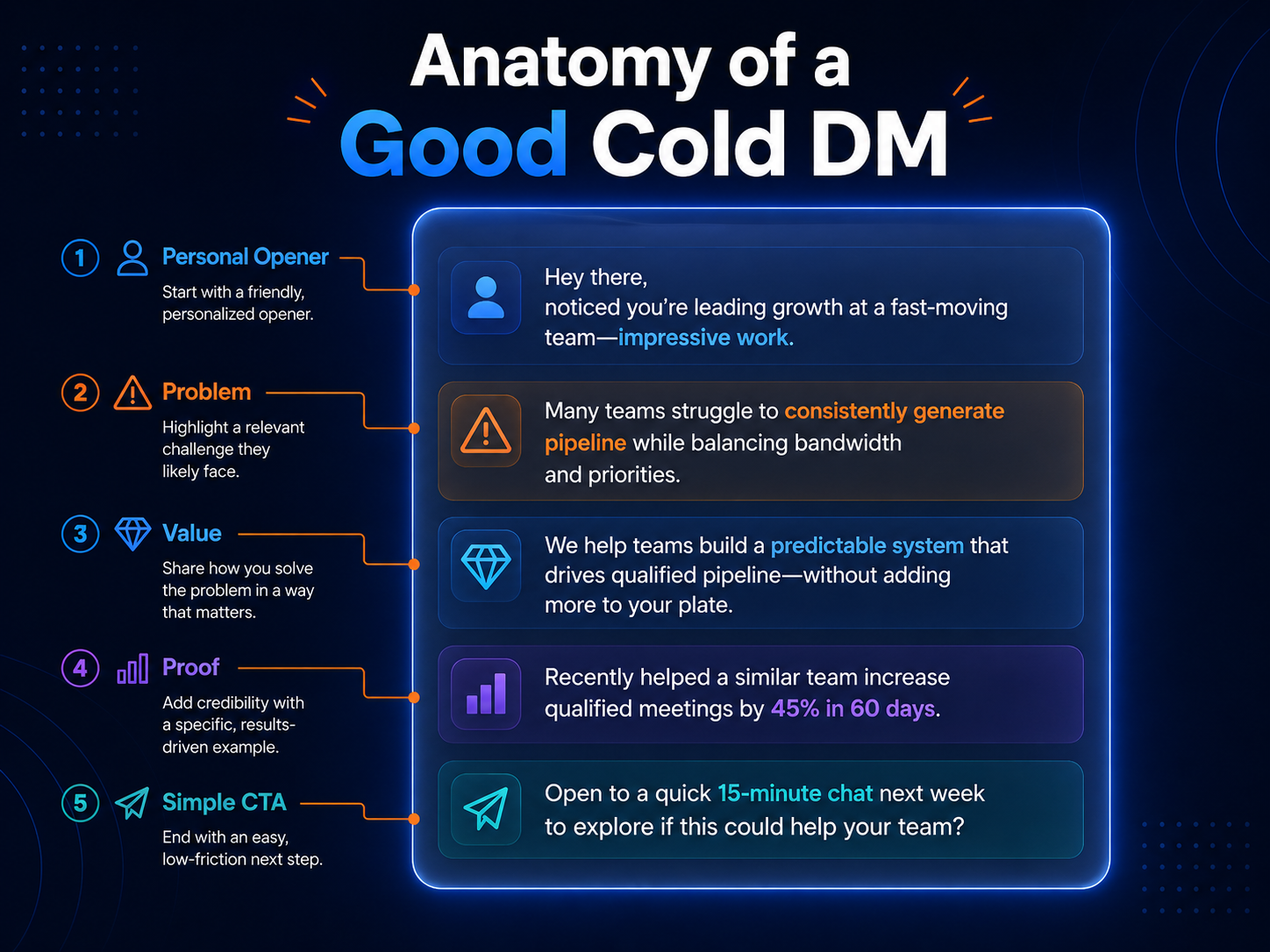
The value line should answer, "Why should I keep reading?" Keep it concrete. If you need two long sentences to explain the value, the offer is probably not clear enough yet.
Step 4: Add Proof Without Bragging
Proof makes the message feel safer. It answers the silent question: "Why should I believe you?" But proof does not need to be loud. One small, relevant proof point is usually enough.
Use proof that matches the recipient's world. If you are messaging a local business owner, a local example is stronger than a huge vague claim. If you are messaging a SaaS founder, a metric from a similar funnel is stronger than a testimonial with no numbers.
"Recently helped a similar team increase qualified meetings by 45% in 60 days."
"Used this same workflow with a 12-person agency that was relying too heavily on referrals."
"One client used this to turn 1,200 monthly DMs into 38 booked calls."
If you do not have big proof yet, use process proof. Mention the audit, teardown, checklist, or idea you can share. A useful insight can create trust before a case study exists.
Step 5: Close With a Simple CTA
The CTA is where good messages often get heavy. Asking for a 30-minute demo, a strategy call, or a full commitment too early creates friction. The first CTA should make replying feel easy.

Simple CTAs work because they ask for a small signal of interest, not a big commitment. The recipient can answer in seconds.
"Worth a quick look?"
"Should I send the idea?"
"Open to seeing it?"
"Want me to share the quick version?"
"Would a 2-minute teardown be useful?"
Put the 5 Steps Together
Here is the full framework in one message. Notice that it does not try to say everything. It earns the next reply.
Hi Maya, I saw your post about scaling content production without losing quality.
A lot of teams hit that exact issue when they try to publish more often.
We help growth teams build a repeatable workflow for turning ideas into posts without adding more review bottlenecks.
Recently helped a similar team increase qualified conversations by 45% in 60 days.
Worth sending over the 3-step version?
That message works because each line has a purpose. The opener proves relevance. The problem shows understanding. The value gives a reason to care. The proof reduces risk. The CTA makes the next step small.
How to Adapt the Framework by Platform
The same framework works across platforms, but the length and tone should change.
| Platform | Best approach |
|---|---|
| Keep it conversational. Use a recent post, reel, story, or offer as the personal signal. | |
| Use business context. Reference role, team growth, company news, hiring, or a recent post. | |
| X / Twitter | Be concise. Reference a thread, opinion, product update, or public conversation. |
| Use community or local context. Keep the message warm and human. | |
| Email follow-up | Expand slightly. Add a clearer subject line and one extra sentence of context. |
Forecast Your Cold DM Funnel
Use Cold DM Calculator to estimate replies, positive replies, booked calls, clients, and ROI before you send the campaign.
Use the Cold DM Calculator →Track the Funnel, Not Just the Reply
A reply is useful, but it is not the whole funnel. If you only track replies, you might optimize for curiosity instead of revenue. Better outreach tracks the whole path from sent message to booked call to client.
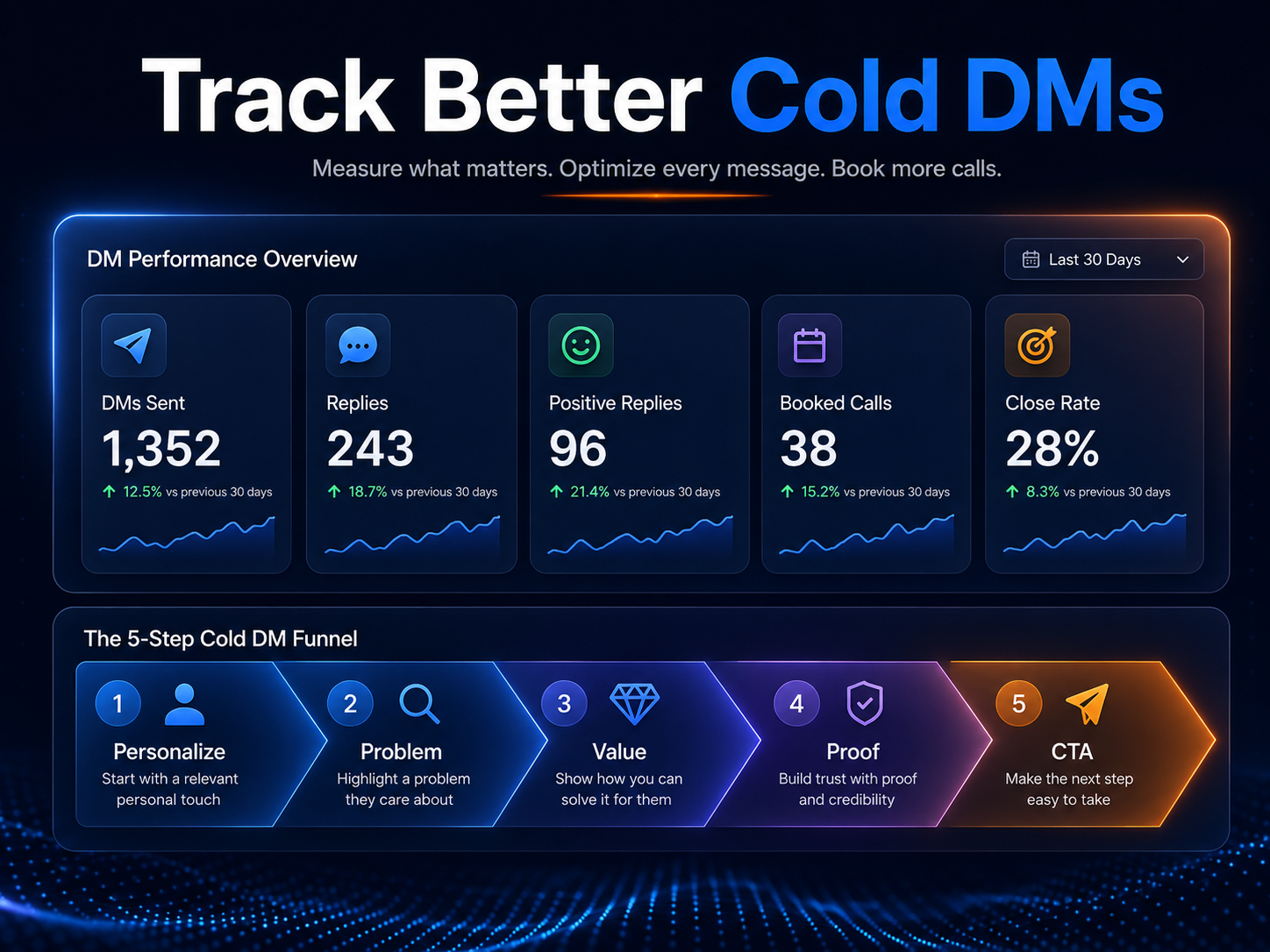
Cold DM funnel math
- DMs sent x reply rate = replies
- Replies x positive reply rate = positive replies
- Positive replies x call booking rate = booked calls
- Booked calls x close rate = clients
When a campaign underperforms, the metric tells you where to fix it:
- Low reply rate: improve targeting, opener, and personalization.
- Replies but few positive replies: clarify the problem and value.
- Positive replies but few calls: simplify the CTA and follow-up.
- Calls but few clients: improve qualification, offer fit, and sales process.
A Practical Writing Checklist
Before sending a cold DM, run it through this checklist:
- Does the first line include something specific to this person?
- Does the message name a problem they likely recognize?
- Is the value stated as an outcome, not a service list?
- Is there a believable proof point or useful reason to trust you?
- Is the CTA easy to answer in one sentence or less?
- Can the whole message be read quickly on a phone?
If the answer is no to any of those, revise before sending. The strongest cold DMs are rarely the longest. They are the ones with the least wasted motion.
Frequently Asked Questions
The 5-step cold DM framework is Personalize, Problem, Value, Proof, and CTA. It gives each line of your message a clear job so your outreach feels relevant, useful, credible, and easy to answer.
Usually, yes, but keep each step short. On fast-moving platforms like Instagram or X, each step might be only a phrase. On LinkedIn or email, you can add a little more context.
The best CTA is small and easy to answer. "Worth a quick look?", "Should I send the idea?", and "Open to seeing it?" are stronger first-message CTAs than asking for a long meeting right away.
Track DMs sent, replies, positive replies, booked calls, close rate, and clients won. Those numbers show whether the issue is your targeting, message, CTA, follow-up, or offer.